Why 92% of Organizations Are Going Multi-Cloud in 2026: A Founder's Guide
As a founder, the “default” choice is often to go all-in on a single provider like AWS or GCP. It’s convenient, but recent data shows that this convenience is becoming a strategic risk. In 2026, 89% to 92% of organizations have already moved to a multi-cloud architecture [1].
The era of the “one-cloud-fits-all” model is over. For early-stage startups, the goal isn’t just to store data; it’s to build an “enterprise nervous system” that is resilient, flexible, and cost-effective.
The Reality of the Multi-Cloud Shift
The move to multiple clouds isn’t just a trend for tech giants. It is driven by three core necessities:
- Strategic Flexibility: 75% of organizations now use multi-cloud strategies to avoid vendor lock-in and optimize workloads across different environments [2].
- Specialized Power: Founders are increasingly using Google Cloud for advanced AI/ML training (Vertex AI) while keeping their core compute on AWS [3].
- Survival Imperative: Outages are inevitable. Multi-cloud architecture is now a “survival imperative,” providing resilience that a single-vendor roadmap simply cannot match [4].
The “Convenience Trap”: Why Your Gateway Matters
The biggest barrier to staying cloud-agnostic is often your API Gateway. Most native gateways (like AWS API Gateway) are designed to keep you inside their walled garden with proprietary configurations and “convenience” features that make leaving nearly impossible [2].
Common Multi-Cloud Headaches in 2026:
- Tool Sprawl: 78% of IT leaders report being “drowned” in fragmented management tools across different clouds [1].
- The Skills Gap: Up to 90% of organizations face severe IT skills shortages by 2026, specifically in managing the unique APIs of multiple providers [2].
- The Cost Conundrum: Managing cloud spend is the #1 challenge for 84% of businesses [5]. Hidden costs, like data egress fees and IPv4 charges, can account for up to 45% of a project’s expenses in data-intensive architectures [1].
Future-Proofing Your Startup with Crate.cc
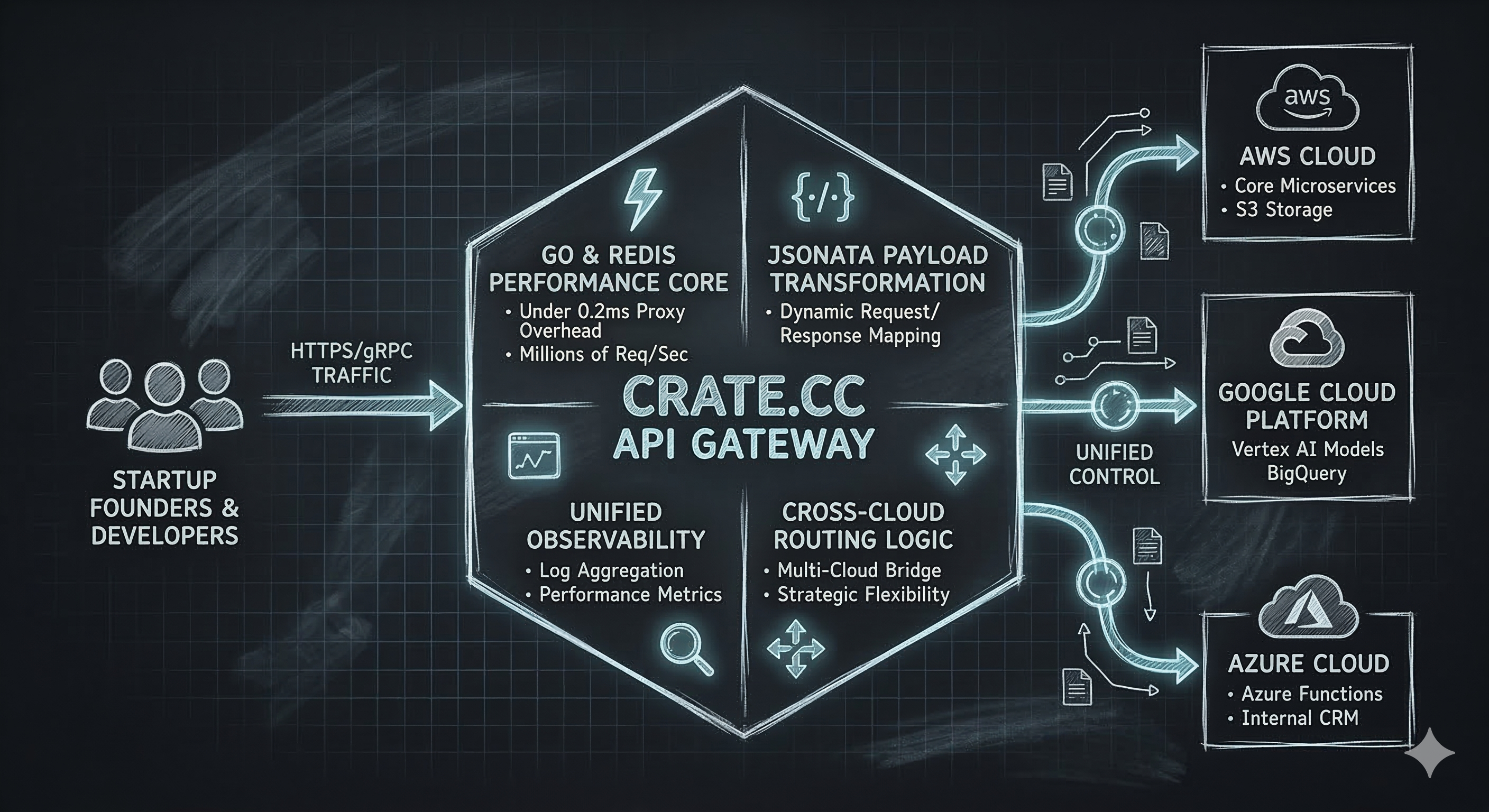
Crate.cc isn’t just a proxy; it’s an autonomous bridge designed to eliminate the friction points of a fragmented architecture.
- Autonomous Reliability: Crate’s data plane is independent. By leveraging a Go-based core and local Redis caching, it maintains routing integrity even if your primary cloud’s management console is unresponsive [4].
- Zero-Latency Transformations: Instead of spinning up “Glue” functions (like AWS Lambda) to bridge incompatible APIs, Crate uses native JSONata engines. This allows for wire-speed payload transformation, saving you both the “Lambda Tax” and the 100ms+ latency overhead [1].
- Intelligent Egress Routing: Crate helps you combat the “45% Hidden Tax” on data egress [1]. By intelligently routing traffic through the most cost-effective paths between providers, Crate turns your infrastructure into a competitive advantage rather than a line-item liability.
- Unified Observability: Stop “dashboard fatigue” by seeing all your downstream errors and performance metrics in one place, regardless of where your servers live.
Final Thought: Start from the Bottom
Trust is the most valuable currency for a founder. Choosing a cloud-agnostic path today means you aren’t just building for right now—you’re ensuring your business has the freedom to grow, pivot, and scale wherever the best technology lives.
Ready to take control of your infrastructure? Signup and check it out